Creating an enabling
environment for research

2. Shaping the global research agenda

TDR engages a wide range of stakeholders, including scientists, funders and governments, to shape the global research agenda on infectious diseases of poverty. This section highlights TDR’s efforts in identifying and prioritizing key research areas, ensuring open and equitable access to scientific data and literature, and fostering an inclusive and equitable research environment. Furthermore, TDR supports efforts to harmonize investments in building research capacity and plays an influential role in the global debate around key health issues via the Global Health Matters podcast. These initiatives collectively drive impactful and inclusive research efforts.

Objective
To support the generation of evidence that strengthens epidemic preparedness and the resilience of health systems.

Key activities

  • Supporting research priority setting exercises.
  • Facilitating equitable open science through research data sharing platforms and open access to research literature.
  • Promoting an inclusive infectious disease research agenda that recognizes the health needs of women, girls, men, boys and people in all their diversity, including those with non-binary identities.
  • Facilitating the harmonization of funders’ investments in research capacity through the ESSENCE on Health Research initiative.
  • Influencing the global debate around key health issues through the Global Health Matters podcast.

2024 updates

  • An opinion article published in the BMJ on the occasion of TDR’s 50th anniversary discussed the Programme’s commitment to and progress on advancing inclusive internationalism in health research. (See Spotlight story below.) A forthcoming BMJ Collection brings together a wide range of stakeholders to advance ideas, debates and actions needed to achieve true equity in global health research.
  • TDR is contributing to WHO’s research priority-setting exercises in knowledge translation and evidence-informed policy-making and those led by the Global NTD Programme and Department of Traditional, Complementary and Integrative Medicine.
  • TDR is leading an initiative to develop guidance to incorporate an intersectional gender lens in ethics review committee evaluations.
A promotional podcast banner showcasing top Global Health Matters podcast episodes of 2024, featuring discussions on geopolitics, malaria elimination, and leadership development represented by portrait images of each speaker related to each episode

Clockwise from top left: Ricardo Baptista Leite, Ayoade Alakija, Wilfried Mutombo, Yasmine Belkaid, John Reeder, Francine Ntoumi and Corine Karema. 

All photos courtesy of guests except for John Reeder Credit: TDR/Antoine Tardy

Spotlight

TDR at 50: advancing a longstanding commitment to inclusion

(published in the BMJ on 28 May 2024)

Calls for inclusivity in health research have been intensifying in recent years. The moves reflect awareness of the importance of creating more equitable and collaborative international partnerships and ensuring that diverse voices, especially from LMICs, are heard and included in all stages of the research process.

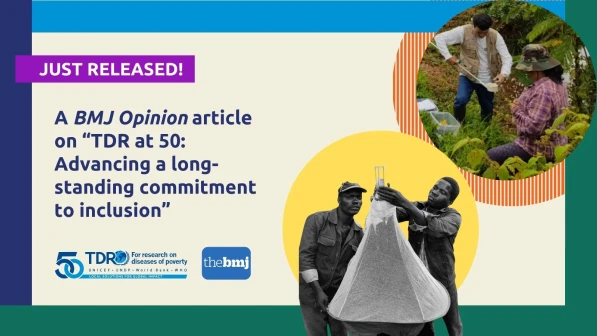
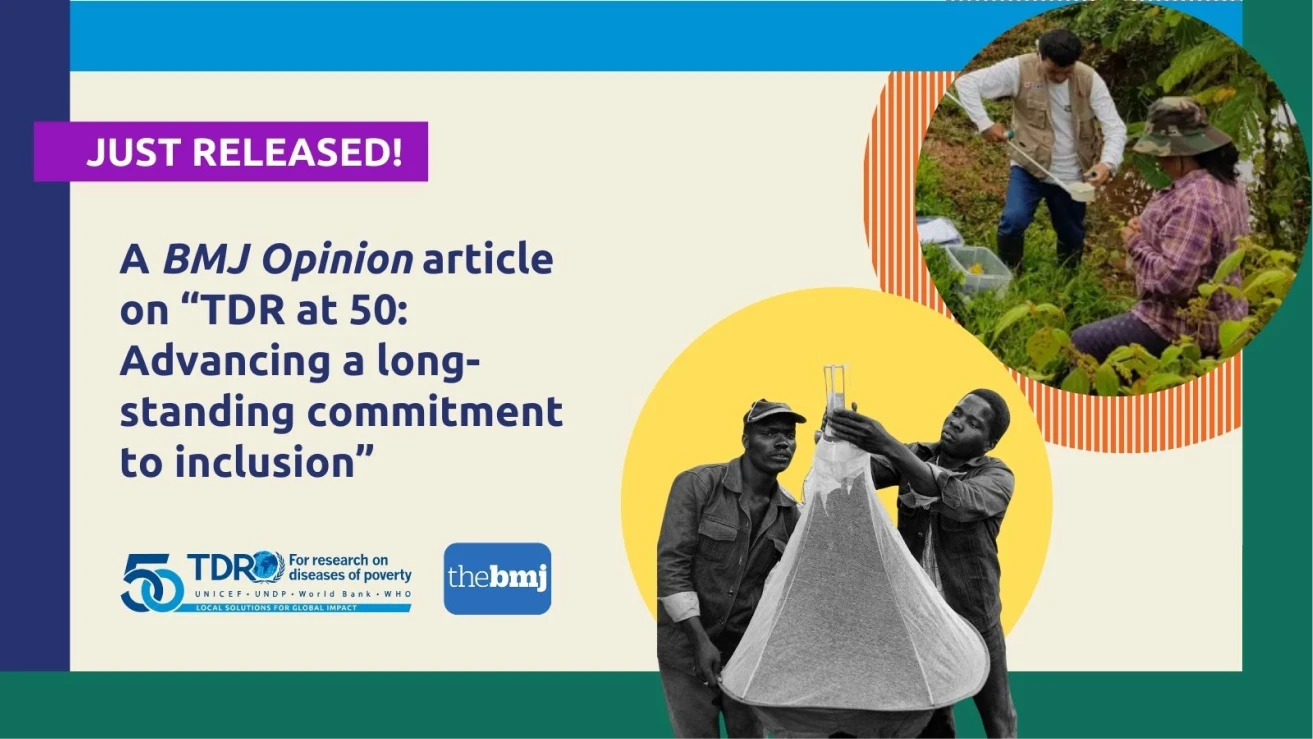
Promotional graphic for a BMJ Opinion article on TDR’s 50-year commitment to inclusion, featuring images of researchers in the field over colourful circle graphics

Top photo: Scientists searching for mosquito larvae in the Peruvian Amazon. 

Credit: Freddy Alava

Bottom photo: African researchers trapping tsetse flies responsible for transmission of sleeping sickness.
Credit: WHO/T. Land

Spotlight

TDR at 50: advancing a longstanding commitment to inclusion

(published in the BMJ on 28 May 2024)

Calls for inclusivity in health research have been intensifying in recent years. The moves reflect awareness of the importance of creating more equitable and collaborative international partnerships and ensuring that diverse voices, especially from LMICs, are heard and included in all stages of the research process.


TDR, which marked its 50th anniversary in May 2024, has sought to contribute to inclusivity through commitments to equitable research partnerships, democratizing health research, and to gender equity. All of these commitments are closely aligned with wider efforts to decolonize global health.

Promotional graphic for a BMJ Opinion article on TDR’s 50-year commitment to inclusion, featuring images of researchers in the field over colourful circle graphics

Top photo: Scientists searching for mosquito larvae in the Peruvian Amazon. 

Credit: Freddy Alava

Bottom photo: African researchers trapping tsetse flies responsible for transmission of sleeping sickness.
Credit: WHO/T. Land

Throughout its history, TDR has had two intertwined missions—to build research capacity in the countries where infectious diseases burden so many, particularly the less advantaged, and to help prioritize and fund the research needed to tackle these diseases. As a global programme of scientific collaboration co-sponsored by UNICEF, UNDP, the World Bank, and WHO, TDR has always aimed to forge partnerships and collaborations with leading research institutions in LMICs. TDR’s longstanding partnership with the Armauer Hansen Research Institute (AHRI) in Ethiopia, for example, has helped catalyse individual, institutional and national research capacity in the country.

Since 2008, TDR has helped convene and coordinate multiple stakeholders to develop guidance that sets a standard for ensuring equitable research partnerships. The approaches build on experiences of funders, research organizations and researchers from low-, middle-, and high-income countries and give practical guidance on how to overcome barriers to equity. Even in the context of equity commitments, strengthening research capacity in LMICs may sometimes be relegated to rhetoric or as an afterthought in research partnerships. TDR leadership has championed giving capacity outputs equal importance to research outputs.
TDR has helped convene and coordinate multiple stakeholders to develop guidance that sets a standard for ensuring equitable research partnerships.
For example, the development of sustainable capacity for malaria research in Africa has been a central part of the Multilateral Initiative on Malaria, launched in 1997 with a funding mechanism established at TDR. More recently, TDR has been aiming to model how to democratize research by making it available as a useful tool for programme implementers, decision-makers, frontline health workers and grassroots social innovators.

Read the full story here.