


The health and well-being of people burdened by infectious diseases of poverty is improved through research and innovation.
TDR
World Health Organization
20 Avenue Appia
1211 Geneva 27
Switzerland
tdr@who.int
Visit our website: tdr.who.int
ISBN 978-92-4-010930-8 (electronic version)
ISBN 978-92-4-010931-5 (print version)
Some rights reserved. This work is available under the Creative Commons Attribution-NonCommercial-ShareAlike 3.0 IGO licence (CC BY-NC-SA 3.0 IGO; https://creativecommons.org/licenses/by-nc-sa/3.0/igo).
Under the terms of this licence, you may copy, redistribute and adapt the work for non-commercial purposes, provided the work is appropriately cited, as indicated below. In any use of this work, there should be no suggestion that the World Health Organization (WHO), including the UNICEF/UNDP/World Bank/WHO Special Programme for Research and Training in Tropical Diseases (TDR), endorses any specific organization, products or services. The use of WHO and TDR logos is not permitted. If you adapt the work, then you must license your work under the same or equivalent Creative Commons licence. If you create a translation of this work, you should add the following disclaimer along with the suggested citation: “This translation was not created by the World Health Organization (WHO) or by the UNICEF/UNDP/World Bank/WHO Special Programme for Research and Training in Tropical Diseases (TDR). WHO, including TDR is not responsible for the content or accuracy of this translation. The original English edition shall be the binding and authentic edition”.
Any mediation relating to disputes arising under the licence shall be conducted in accordance with the mediation rules of the World Intellectual Property Organization.
Suggested citation. TDR annual report 2024: building local research solutions to improve global health. Geneva: World Health Organization; 2025. Licence: CC BY-NC-SA 3.0 IGO.
Cataloguing-in-Publication (CIP) data. CIP data are available at https://iris.who.int/.
Sales, rights and licensing. To purchase WHO publications, see https://www.who.int/publications/book-orders. To submit requests for commercial use and queries on rights and licensing, see http://www.who.int/copyright.
Third-party materials. If you wish to reuse material from this work that is attributed to a third party, such as tables, figures or images, it is your responsibility to determine whether permission is needed for that reuse and to obtain permission from the copyright holder. The risk of claims resulting from infringement of any third-party- owned component in the work rests solely with the user.
General disclaimers. The designations employed and the presentation of the material in this publication do not imply the expression of any opinion whatsoever on the part of WHO, including TDR, concerning the legal status of any country, territory, city or area or of its authorities, or concerning the delimitation of its frontiers or boundaries. Dotted and dashed lines on maps represent approximate border lines for which there may not yet be full agreement.
The mention of specific companies or of certain manufacturers’ products does not imply that they are endorsed or recommended by WHO, including TDR, in preference to others of a similar nature that are not mentioned. Errors and omissions excepted, the names of proprietary products are distinguished by initial capital letters.
All reasonable precautions have been taken by WHO, including TDR, to verify the information contained in this publication. However, the published material is being distributed without warranty of any kind, either expressed or implied. The responsibility for the interpretation and use of the material lies with the reader. In no event shall WHO, including TDR, be liable for damages arising from its use.
Cover page photo. ©
Cover caption: Angel Michael (centre) delivers her child’s urine and stool sample to Ngw’ashi Dotto Haga (left), a community health care worker, as part of the baseline parasitological assessment study.
Credit: UNDP/Kumi Media
It is with great pride that I present the TDR 2024 Annual Report, reflecting back over the last year. The year marked a significant milestone for TDR as we celebrated our 50th anniversary. Over the past five decades, TDR has been at the forefront of advancing global health through research and innovation. While celebrating our rich history, we have our eyes firmly on the present and the future. The achievements of 2024 have continued the proud tradition but show us stepping confidently towards the next phase.
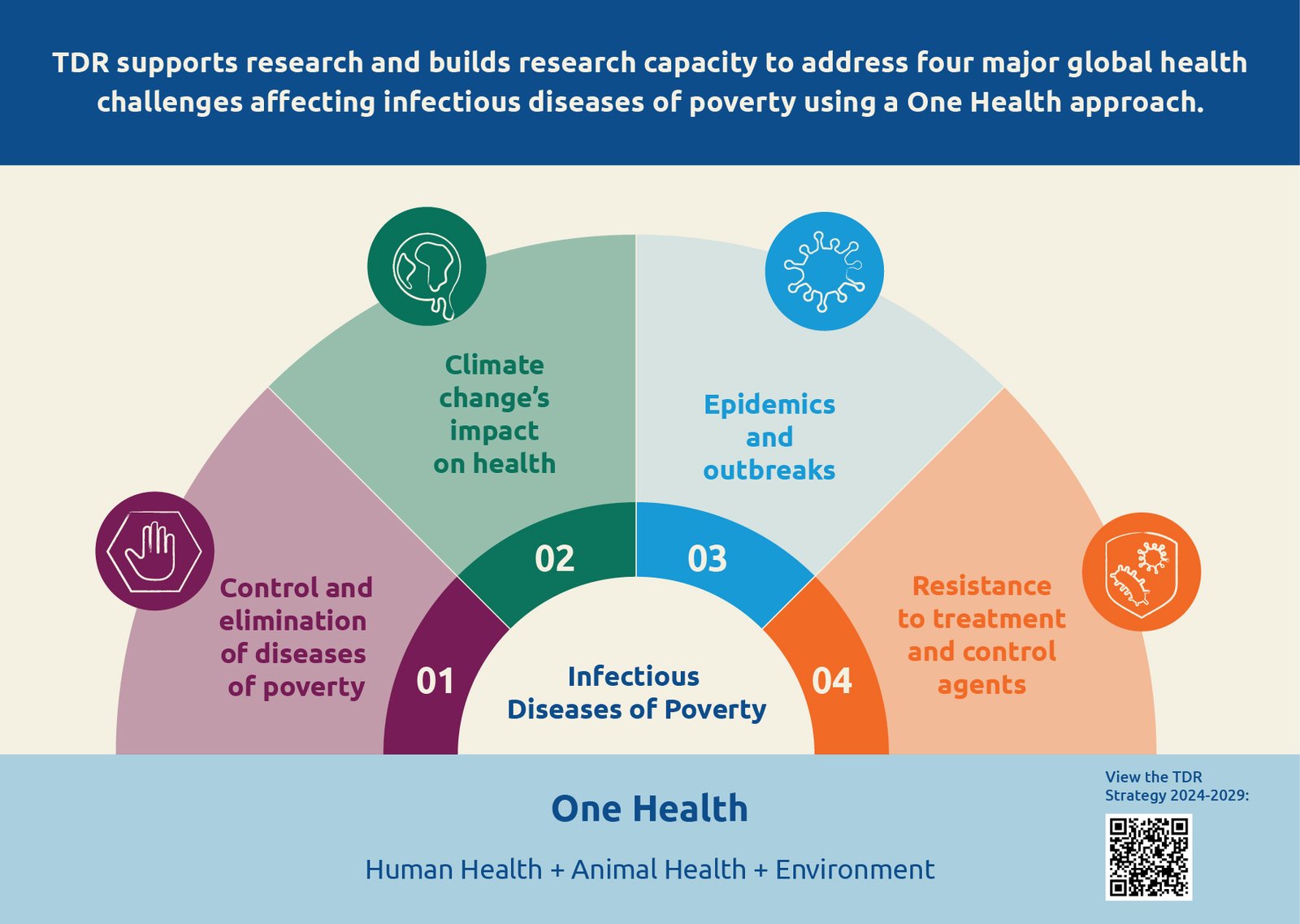
Below are just a few highlights of activities in 2024 addressing these challenges.
Control and elimination of diseases of poverty
TDR’s long involvement with the development of drugs for neglected diseases took another positive step forward when Ghana approved moxidectin for the treatment of river blindness. This first-of-its-kind approval paves the way for a TDR-supported pilot implementation programme, which demonstrates our continued commitment to eliminating neglected tropical diseases and improving the health of vulnerable populations.
Climate change’s impact on health
The TDR-led Early Warning and Response System for climate-sensitive diseases (EWARS-csd) is a key approach to mitigating the impact of climate change on health in low- and middle-income countries. In 2024, we successfully piloted EWARS-csd in three additional countries in West Africa: Burkina Faso, Nigeria and Senegal. This is just one example of our efforts to strengthen the resilience of health systems so that they can respond effectively to climate-related health threats.
Epidemics and outbreaks
The best way to support countries to prepare for and address epidemics and outbreaks is to build sustainable, flexible and responsive public health research capacity. In pursuit of this, we have developed and piloted a research package for conducting root cause
Resistance to treatment and control agents
Antimicrobial resistance is a huge global threat, but often this focuses just on antibiotics and neglects other treatment and control agents crucial to the response to diseases of poverty. TDR-supported studies have led to national policy changes in the Dominican Republic and Ecuador, where short all-oral regimens for drug-resistant TB patients have been adopted. This development highlights the impact of TDR-supported research on national health policies.
As we reflect on the impact TDR has had on the field of global health over the past 50 years, we remain committed to advancing inclusive internationalism in health research. An opinion article published in the BMJ on this occasion highlighted our progress and dedication to this cause. I hope that you are able to read it.
Taking on the role of Chair of TDR’s Joint Coordinating Board is both a privilege and a responsibility. I am dedicated to building on the work of my predecessors and guiding our efforts towards meaningful impact. The JCB plays a crucial role in coordinating the interests and responsibilities of all parties involved with TDR, ensuring that our strategies and actions are aligned with our overarching goals.
This year, we have seen progress in our mission to empower countries to lead their own health research agendas. TDR’s emphasis on enabling country leadership is not just a strategic priority; it is a fundamental principle that underpins our approach to addressing infectious diseases of poverty. By supporting country-led research, we are fostering sustainable solutions that are tailored to the unique needs and contexts of the communities we serve.
The importance of a health systems approach cannot be overstated. Strengthening health systems is crucial for the effective prevention, detection, and response to infectious diseases. TDR’s work in building research capacity within health systems ensures that countries are better equipped to tackle current and emerging health challenges. Our efforts in implementation research have
demonstrated the value of integrating research findings into health policies and practices, ultimately leading to improved health outcomes.
In 2024, we have continued to support innovative research that addresses the most pressing health issues. In exploring the challenges of implementing new tools and strategies for addressing diseases such as malaria, tuberculosis, and neglected tropical diseases, TDR is making a tangible difference in the lives of those most affected by these conditions. The success of our initiatives is a testament to the dedication and expertise of all stakeholders.
As we look to the future, I recognize that the path ahead is fraught with challenges. TDR will need to navigate the complex landscape of global health with a continued commitment to equity, collaboration, and scientific excellence. Together, we can strive to improve the health and well-being of people burdened by infectious diseases of poverty.
Thank you for your support and partnership. I look forward to working with all of you to advance our shared goals and make a lasting impact on global health.
As TDR Special Programme Coordinator, I am honoured to present the TDR annual report 2024. This past year has been marked by significant progress and innovation, driven by our collective commitment to improving global health through research and capacity building.
TDR’s mission to foster an effective global research effort on infectious diseases of poverty remains as critical as ever. In 2024, TDR continued to build on a strong foundation, established over its 50-year history, advancing research that addresses the health challenges faced by the most vulnerable populations. Its work is guided by the principles of equity, collaboration and scientific excellence, ensuring that the benefits of research reach those who need them most.
The past year marked a strong start to the implementation of the TDR Strategy 2024-2029. This strategy emphasizes the importance of local research solutions, empowering communities to take charge of their health challenges.
By supporting country-led research initiatives, we are not only addressing immediate health needs but also building sustainable research capacity for the future. This approach has proven to be effective in generating innovative solutions that are tailored to local contexts and needs.
As we look ahead, the challenges we face are formidable, but so are the opportunities. The intersections between climate change, global migration and health present challenges that require innovative and interdisciplinary approaches. TDR is well positioned to lead the way in addressing these complex issues through strategic partnerships. Our commitment to the principles of universal health coverage will continue to guide our efforts in ensuring that no one is left behind.
In closing, I would like to express my deepest appreciation to the TDR team and the global health community for their tireless efforts and contributions. Together we have made significant strides in advancing global health, and I am confident that we will continue to achieve even greater impact in the years to come.