Governance and financial performance
1. Governance and management
TDR is co-sponsored by UNICEF, UNDP, the World Bank and WHO, and it is through these international, multilateral organizations that TDR has such an extensive reach and support. WHO acts as the executing agency of the Programme and provides close ties with its departments for a continuous loop of research informing policy and policy informing research, which in turn supports planning and priority setting at international, regional and national levels.
TDR’s overall management responsibility is ensured by the TDR Special Programme Coordinator, Dr Jeremy Farrar, who heads WHO’s Science Division as Chief Scientist. Day-to-day management is provided by the TDR Director. Thirty full-time staff and additional project-specific short-term staff come from all regions of the world.
Joint Coordinating Board
TDR’s top governing body is its Joint Coordinating Board (JCB), which includes a mix of representatives from developed and developing countries (see figure below).
The Board comprises 28 members: 12 members selected by the resource contributors to the Programme (including four constituencies of two or more governments sharing one seat); six government representatives chosen by the six regional committees of WHO; six members representing other cooperating parties selected by the JCB itself; and the four cosponsoring agencies.
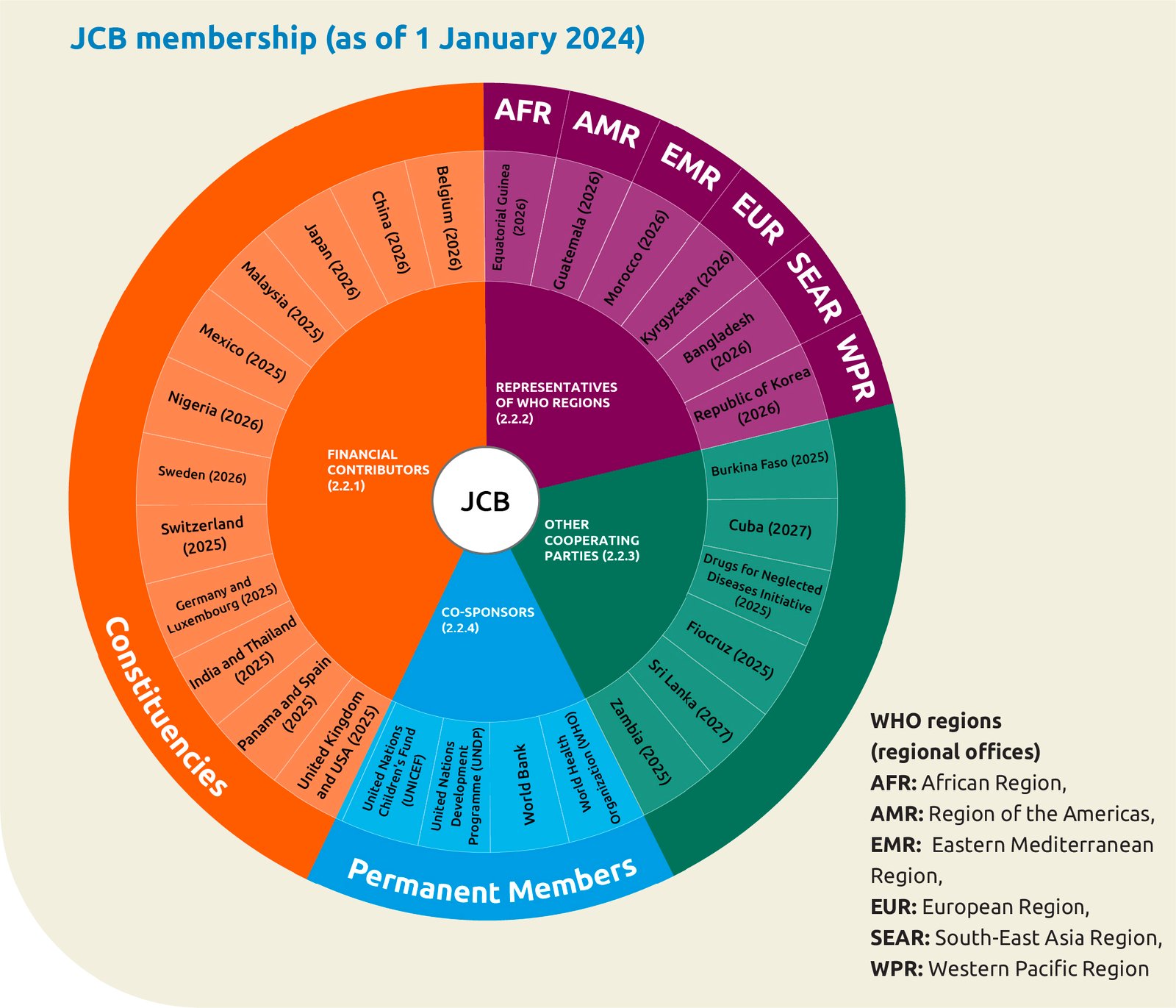
A Standing Committee composed of representatives from the four co-sponsoring agencies, the Chair and the Vice-chair of the JCB, the Chair of the Scientific and Technical Advisory Committee (STAC), one representative from the JCB resource contributors group (a JCB member under paragraph 2.2.1 of the TDR Memorandum of Understanding–MOU), and one representative from a disease endemic country (which may be a JCB member under any paragraph of the MOU), provides guidance and oversight on an ongoing basis.
Scientific and Technical Advisory Committee
STAC is TDR’s overarching advisory body, as foreseen in the MOU, which oversees the Programme’s scientific and technical strategies, directions and priorities. STAC provides its recommendations to the JCB and the TDR Secretariat. The Committee includes internationally recognized scientists, with members serving in their personal capacities to represent a range of research disciplines.
Term of office: until 30 June
(Chair) Professor Margaret Gyapong, Director, Institute of Health Research, University of Health and Allied Sciences, Ho, Ghana
2026
Professor Karen Barnes, Professor, Division of Clinical Pharmacology, Department of Medicine, University of Cape Town, Cape Town, South Africa
2026
Professor Afif Ben Salah, Full Professor of Community Medicine, College of Medicine and Medical Sciences, Department of Community and Family Medicine, Arabian Gulf University, Manama, Kingdom of Bahrain
2025
Professor Claudia Chamas, Researcher, Centre for Technological Development in Health, Oswaldo Cruz Foundation (Fiocruz), Rio de Janeiro, Brazil
2025
Dr Theeraphap Chareonviriyaphap, Head, Department of Entomology, Kasetsart University, Bangkok, Thailand
2025
Dr Sara Irène Eyangoh, Directeur Scientifique, Centre Pasteur du Cameroun, Laboratoire National de Référence et de Santé Publique | Ministère de la Santé Publique, Yaoundé, Cameroon
2024
Professor Debra Jackson, Takeda Chair in Global Child Health and Co- Director of the MARCH Centre, London School of Hygiene & Tropical Medicine, London, United Kingdom
2026
Professor Mirkuzie Woldie Kerie, Senior Research Adviser (SRA), MCH Directorate, Federal Ministry of Health, Jimma, Ethiopia
2025
Dr Caroline Lynch, Regional Adviser, Medicines for Malaria Venture, Chiang Mai, Thailand
2024
Dr Thabi Maitin, Division Manager, Research Grants and Scholarship Funding, South African Medical Research Council, Tygerberg, South Africa
2025
Professor Catherine (Sassy) Molyneux, Professor in Global Health, Health Systems Research Ethics Department, KEMRI- Wellcome Trust Research Programme, Kilifi, Kenya
2025
2025
Dr Emelda Aluoch Okiro, Head, Population Health Unit, KEMRI/Wellcome Trust Collaborative Programme, Nairobi, Kenya
2026
Professor Leanne Robinson, Program Director, Health Security, Senior Principal Research Fellow, Group Leader, Vector-Borne Diseases and Tropical Public Health, Burnet Institute, Melbourne, Australia
2025
Professor Stephen Bertel Squire, Professor of Clinical Tropical Medicine; Dean of Clinical Sciences and International Public Health, Liverpool School of Tropical Medicine, Liverpool, United Kingdom
2025
Dr Marta Tufet Bayona, Head of Policy, Gavi, Geneva, Switzerland
2025
Professor Andrea Winkler, Co (joint)-Director, Center for Global Health, School of Medicine, Technical University of Munich, Germany
2026
1Dr Mwinga passed away in September 2024.
In addition, the TDR Secretariat convenes a scientific working group to review and provide advice on the prioritization of proposed activities and the selection of projects for funding, to review and evaluate progress in that regard and make recommendations to the Secretariat. Reviews cover the three core areas of TDR: research for implementation, strengthening research capacity and global engagement.